ADMIN
๋°ADMIN๋°
 Inregistrat: acum 18 ani
Postari: 5324
|
|
Emo is a somewhat ambiguous slang term most frequently used to describe or refer to the fashion, style, attitude or overall subculture linked to post-hardcore fashion and its subculture. Emo may also describe emo music or a general emotional state (as in to "feel emo". It is also, sometimes pejoratively, used to identify someone fitting a particular emo stereotype or category, or of being overly-emotional.The term's definition is the subject of debate.
Music
Main article: Emo (music)
The term emo originated in the 1980s to describe a genre of music stemming from the emotional punk scene in Washington, D.C. Early bands labeled emo (or sometimes emocore, short for emotional hardcore) in this scene included Rites of Spring and Embrace. The term emo as a music genre has become more broad over time and now is loosely understood to define rock music with emotionally-based lyrics or effect. It is used to describe a broad, poorly defined group of bands that might include nearly any popular (or unpopular) rock band. Arguable examples of bands labeled as such are Hawthorne Heights, Innovator, AFI and My Chemical Romance.
Personality
When referring to a person's personality and attitude, most definitions of emo hold that an emo person is emotionally candid, sensitive, shy, introverted, glum, and quiet.Depression and broken-heartedness are sometimes used to describe the emo personality. The factuality of broken-heartedness as a personality trait stems from the opinion that emo music contains multiple references to unrequited love, emotional and relationship problems.
Poetry
Emo personality is also often connected with writing poetry that addresses: confusion, depression, loneliness, the futility of life, and anger, all resulting from the world's inability to understand the author. Emo poetry usually combines a highly emotional tone and stream of consciousness writing with a simple (ABAB) or nonexistent rhyme scheme, references to the flesh (especially the heart), heavy use of macabre or depressing adjectives, and concern over the mutability of time, love, or both. A common theme is the author's feeling of emotional pain, or how misunderstood the author feels.
Fashion
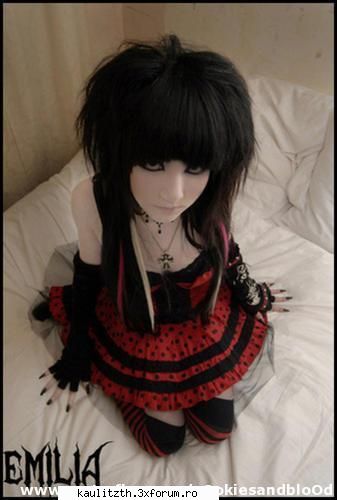
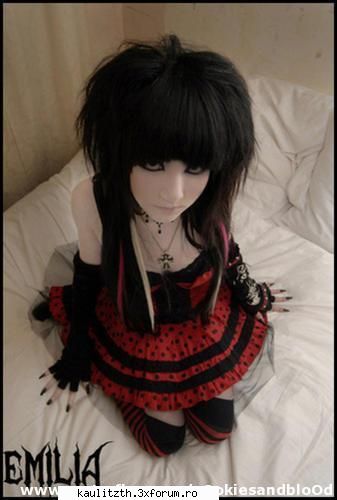
By almost all current definitions, Emo clothing is characterized by tight jeans on males and females alike, long fringe (bangs) brushed to one side of the face or over one or both eyes, dyed black, straightened hair, tight t-shirts which often bear the names of rock bands (or other designed shirts), studded belts, belt buckles, canvas sneakers or skate shoes or other black shoes (often old and beaten up) and, if they wear glasses, they will often be thick, black horn-rimmed glasses. Emo fashion has changed with time; early trends included haircuts similar to those worn by the Romulans and Vulcans in Star Trek, tightly fitting sweaters, button-down shirts, and work jackets (often called gas station jackets).
Criticism
In the years since emo music's rise in popularity, it has attracted severe criticism. Emo has been characterized as a fad that will be discarded and forgotten in the near future.] Critics cast the fashion as "embarrassing," and the people as imagining or pretending that they lead harsh, painful lives when they actually live in comfortable homes.
Members of the emo subculture are portrayed as melodramatic, self-pitying teenagers who pour their efforts into writing depressing poetry. The current emo subculture has been called a "sad caricature" of what it once was.Some have accused emo of celebrating self-injury or suicide, which those who do usually refer to "helping ease the pain". However, physical trauma triggers the release of beta-endorphins, which enhances relaxation and reduces physical pain. Some assert that within some emo circles, many pretend to be suicidal and self-harming as a way to gain acceptance, regardless of whether it is true or not.
Most people have a horribly limited idea of what emo is, simply because the most important records in the development of emo were largely released on vinyl, in small numbers, and with limited distribution. These were however very influential, so nowadays you have the situation that a lot of kids listen to third- and fourth-generation emo styles without even knowing it. I hope to expose such people to a wealth of great preceding music that's getting easier to find all the time...
I'm going to split up the mass of "emo" bands into a few distinct genres. Like any categorization effort, there will be exceptions, crossovers, and tangential relations. That's fine. The intent is only to lay out some general trends, general notes on sounds, musical and lyrical themes, and how to listen for them.
Some notes on nomenclature. There isn't a real consensus on what "emo" and "emocore" are, or if they are even different. It's pretty clear these days what you're talking about with terms like "punk," "postpunk," "no-wave," "hardcore punk," "old-school/new-school," etc (although the difference between "hardcore punk" and "hardcore" is lost on a lot of people - "hardcore punk" is punk rock made heavier, faster, louder; "hardcore" is what happened after the hardcore punks realized they didn't have to sound like punk rock anymore - still heavy, fast, loud, but with a different foundation.) I hope to draw clear distinctions between my categories, assign them names, and use them consistently. That's all that language is.
"emo." Moss Icon, the Hated, Silver Bearings, Native Nod, Merel, Hoover, Current, Indian Summer, Evergreen, Navio Forge, Still Life, Shotmaker, Policy of Three, Clikatat Ikatowi, Maximillian Colby, Sleepytime Trio, Noneleftstanding, Embassy, Ordination of Aaron, Floodgate, Four Hundred Years, Frail, Lincoln, Julia, Shroomunion, some early Unwound, etc.
-Started in the DC area in 1987/88 with bands inspired by that area's post-hardcore acceptance of new, diverse sounds within the punk scene. Moves onward to New Jersey and California, then onward to Philly, Richmond VA, a bit in Canada, a bit in Illinois, and not much else.
-Musically there's a lot dynamics between ultra-soft / whispered vocals / twinkly guitar bits and full-bore crashing / twin Gibson SG guitar roaring / screaming vocals. One of the most recognizable and universal elements of emo shows up in the guitar sound of this style: the octave chord. Octave chords give this style a high-pitched, driving urgency and a very rich texture. The Gibson SG / Marshall JCM-800 guitar combo and Ampeg 400 bass amp is the classic emo gear. Solid-state amps are unheard of.
-The vocal style is usually much more intense than emocore, ranging from normal singing in the quiet parts to a kind of pleading howl to gut-wrenching screams to actual sobbing and crying. Straight-edge boys tend to hate that part, and much derision is levelled at emo bands on this point. Most emo bands tend to have some epic-length songs that build up very slowly to a climax where someone cries. If you're receptive to this kind of thing, it can be extremely powerful and moving, since it's very hard to fake that kind of pure emotion convincingly.
-Lyrics tend toward somewhat abstract poetry, and are usually low in the mix and hard to decipher. Record inserts have lyrics, but often so disorganized and haphazard that they're very difficult to read [unless the record was released on Ebullition Records, in which case there are many inserts on small, brightly-colored papers containing poetic writing from the label owner and all his friends about disillusionment, anger, and things that happened when the writer was four. Such writing is known as emo writing, and there are many, many zines just like that]. Said inserts are almost always done with antique typewriters or miniscule hand-lettering, containing no punctuation or capitalization. Often the only information about the band listed is the band members' first names. Another trait of really emo records is to have no information whatsoever about song titles.
-Artwork, too, tends toward abstract black-and-white photographs of rusted/broken things (especially machinery), drawings of flowers, and pictures of old men, little boys, and little girls. Lots of live photos indicates the band is probably from the East Coast, and probably listened to straight-edge at some point.
-Live emo bands tend to play with backs to the audience during the quiet parts. During the loud exploding parts, the musicans have a tendancy to jump and shake unpredicatable and knock things over - especially mike stands. Combine this with the fact that the singers often fail to make it to the mike in time to sing, and decide just to scream at the absolute top of their lungs wherever they are when the time comes, means that often entire shows will pass without the audience being able to hear the vocals. If, however, the band has a lot of screaming during the quiet parts, this can be an extremely powerful tactic.
-The is a particular emo dance sometimes seen in the audience at emo shows. It's known as "the emo tremble." The trembler clasps his/her hands together (wringing them from time to time), leans forward, bounces quickly on the balls of the feet, and shakes the upper torso in time to the music. Once in a while the trembler will grab the back of the head and rock back and forth. The more the person likes the band, the more he or she will double over. Also, a reader submits: "i think you forgot the "emo chest tap" or just "the chest tap". this goes on a lot in the northeast...i particularly remember lots of chest tapping occuring at shotmaker shows."
-Commercialism is very much repressed in this emo scene. Few bands make t-shirts. Most records are put out on very small, home-run labels or on the band's private label. Records are sold cheap (the classic pricing scheme was $3 7"s, $5 LPs, and $8 CDs. Inflation has driven these prices up in recent years). Shows are univerally $5 or less, and touring bands often are lucky to get gas money (despite the promoter usually not paying local bands).
-There is also a bias against digital technology within most bands. Emo recordings tend to be analog only, cheaply done, with a tendency toward mostly live tracking with few overdubs. Equipment is heavily weighted toward tube gear. Until recently, most emo records were made on vinyl only. CD reissues of broken-up bands' discographies are becoming common, though.
-Lastly, emo bands tend not to last long. It was not uncommon an emo band's only recording to come out posthumously and much delayed. Obviously, this puts a damper on the distribution of the records since no one in the band puts much effort into promotion.
-a modern perspective: the term "screamo" is used a lot nowadays to describe bands that are based most heavily on this kind of music.
|
|










 )
)





 pfffz
pfffz